Recover text
OCR proposes labels and locations; users review the suggestions before glyph pixels become native SVG or PowerPoint text.
Image2Other Research prototype
Tongji University
Working title · ongoing research
Swipe to inspect the figure ↔
Scientific figures are often available only as flattened images, making even a small revision difficult. Existing conversion workflows may recover visual similarity while leaving labels, shapes, and connections hard to edit independently. We study a stricter reconstruction goal: an editable scene whose text is legible, whose relationships remain valid after a local change, and whose untouched regions stay stable. Our current prototype combines reviewed OCR suggestions, vector tracing, scene-level editing, and render–compare feedback. These components define an engineering baseline and a candidate evaluation protocol; they do not yet establish a new trained method or measured research result.
Research direction
The current system separates recognition, geometry, and relationships rather than treating the exported SVG as one traced image.
OCR proposes labels and locations; users review the suggestions before glyph pixels become native SVG or PowerPoint text.
Raster regions are traced into vector paths. The scene editor supports explicit shapes, lines, and manually assigned connector targets.
The exported scene is rendered back to pixels. A bounded local position search can reduce image error for selected layers.
Planned experiments will ask whether edits preserve text, connections, and untouched regions—and whether a compact model helps.
Engineering prototype
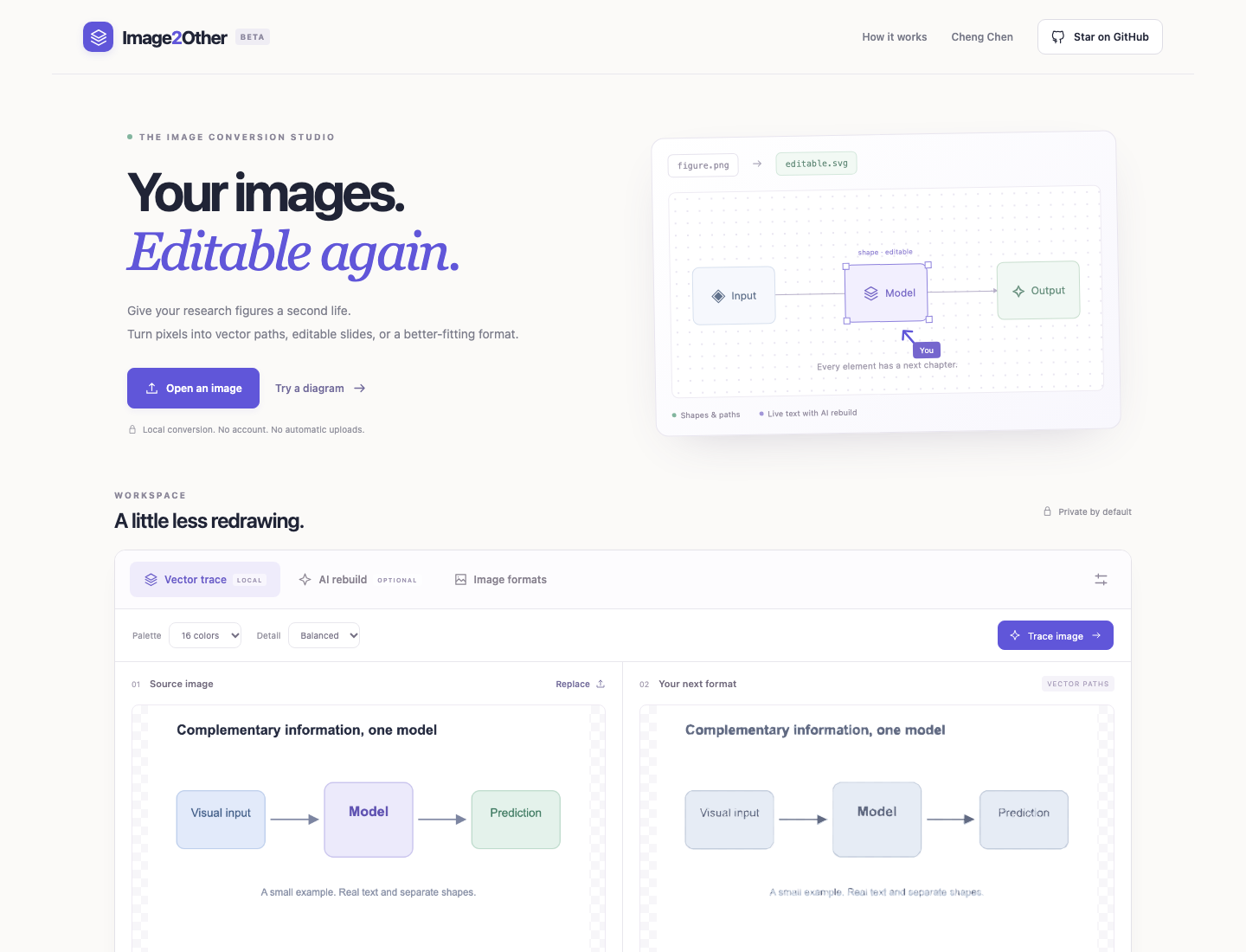
Upload a figure, review OCR suggestions, trace artwork, edit scene layers, and export SVG or PowerPoint. The live tool also includes separate image and document converters.
Evaluation plan
A candidate benchmark would pair source figures with verified structure and controlled edit tasks. The axes below are a plan, not published results.
Pixel error alone cannot certify semantic correctness; held-out tasks and human-checked labels are needed before claiming improvement.
Available now: a browser converter, editable SVG/PPTX export, a reviewed text workflow, and an optional local PaddleOCR bridge.
Still open: fonts and semantics remain approximate; equations, handwriting, rotated labels, and automatically inferred connections are difficult. No trained model weights or benchmark dataset have been released. A paper and controlled evaluation are still in progress.